Run in high availability
A single instance of each service is enough to serve users, but it makes every restart an outage. This page adds redundancy: a shared database, more than one instance of each service, and rules that keep a node or host failure from taking the deployment down.
Work through the steps in order. Adding replicas before moving off SQLite corrupts data.
What limits each service
| Service | Holds state? | What lets it scale |
|---|---|---|
| Platform API | Yes, in its database | A shared PostgreSQL or SQL Server instance, instead of the SQLite file |
| AI Workspace | Yes, in memory: user sessions | Session affinity, so each user keeps reaching the instance holding their session |
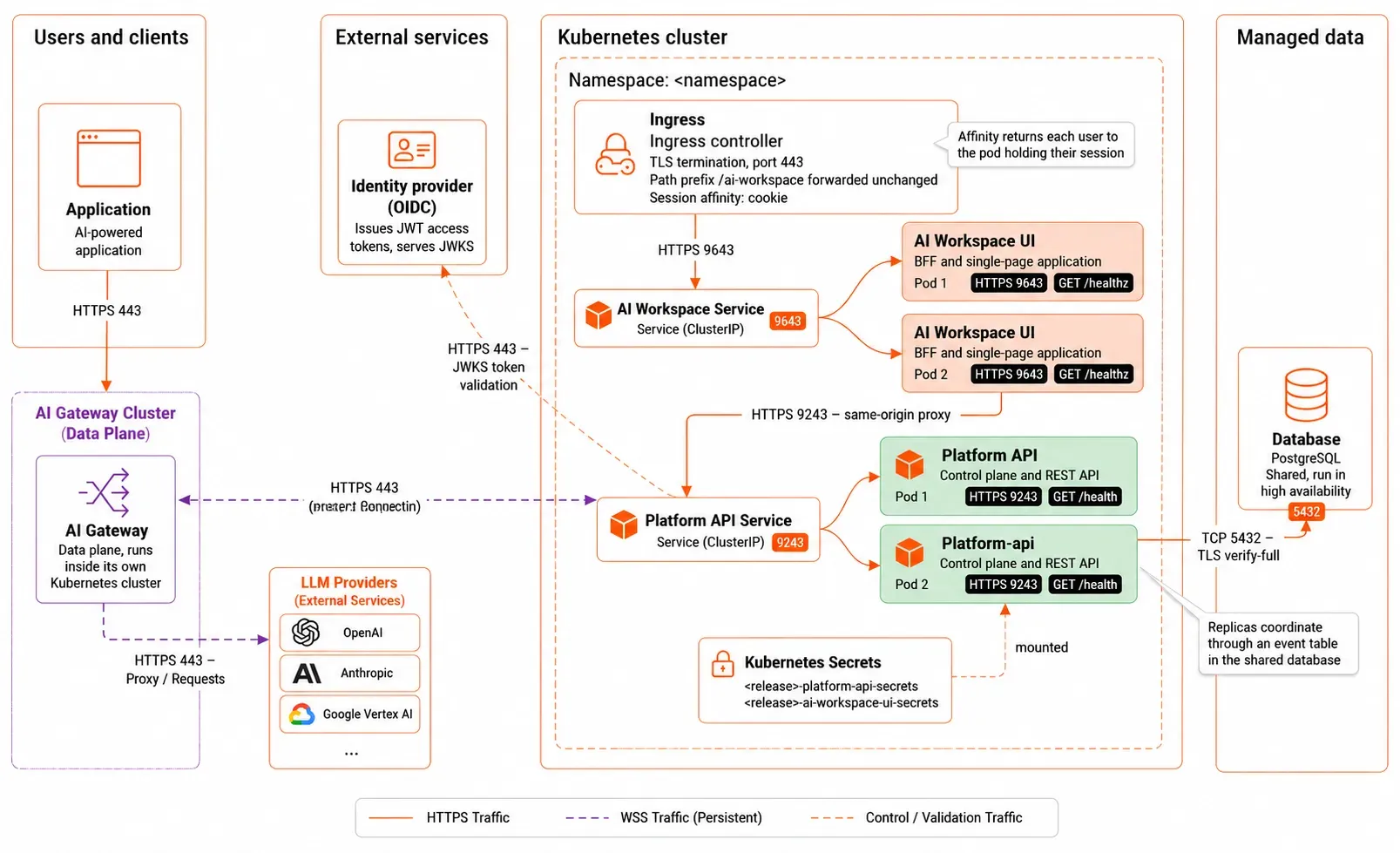
The Platform API coordinates across replicas through an event table in the shared database. Each replica polls it, so a change one replica makes reaches the others without direct communication between them.
The following diagram shows the resulting topology, with both services replicated behind ClusterIP Services, an ingress in front, and the shared database behind:
Step 1: Move to a shared database
SQLite is a file on one disk. Two instances writing to it corrupt it, so it caps the Platform API at one replica.
Move to a database server before anything else on this page. The examples below use PostgreSQL; Microsoft SQL Server works the same way with its own driver value and connection settings. For the full procedure, covering how to create the database and role, provision the schema, and enable TLS, see Connect a database to the Platform API.
Two settings matter for availability once the database server is in place:
- Run the database itself in high availability. A single database server leaves the whole control plane dependent on one machine. Use a managed service with automatic failover, or a replicated cluster.
- Size the connection pool per replica, not per deployment.
max_open_connsapplies to each Platform API instance. Three replicas at 25 connections each need at least 75 connections on the server, plus headroom for maintenance and other clients.
platform-api:
  config:
    database:
      driver: postgres
      postgres:
        host: postgres.example.com
        port: 5432
        name: platform_api
        user: platform_api
        sslMode: verify-full
        sslRootCert: /etc/platform-api/tls/ca.pem
        maxOpenConns: 25
        maxIdleConns: 10
        connMaxLifetime: 300
On Kubernetes the connection keys sit under config.database.postgres whatever the driver, so use that block for SQL Server too.
With a database server in place, you can turn off the persistent volume claim. Do this only when certificates come from cert-manager or a Secret rather than the volume:
Step 2: Give every instance the same key material
All instances must use the same at-rest encryption key so they can decrypt data written by other instances. If an instance uses a different key, it cannot read data encrypted by another instance.
- Kubernetes: This is handled automatically when all pods use the same Kubernetes Secret containing the encryption key.
- VM deployments: Copy the same encryption key files to every host and verify that the files are identical before routing traffic to the instances. See Provision secrets and keys.
Step 3: Add replicas
Run the same Compose stack on two or more hosts, each with:
- Identical
config.tomlfiles, apart from anything genuinely host-specific. - The same encryption key.
- The same database connection.
- A certificate valid for the public hostname, or plain-HTTP listeners behind a TLS-terminating load balancer.
Put a load balancer in front of the hosts, health-checking /healthz on the workspace port and /health on the Platform API port. Remove a host from rotation before you upgrade it, then add it back once its health check passes.
Configure session affinity on the workspace pool. The BFF keeps sessions in memory, so a user routed to a different host mid-session is signed out. Most load balancers call this sticky sessions or source affinity; a cookie-based method is more accurate than one based on client IP address.
The Platform API pool needs no affinity. Any replica serves any request.
Raise the replica counts:
platform-api:
  deployment:
    replicaCount: 2      # requires a database server, not sqlite3

ai-workspace-ui:
  deployment:
    replicaCount: 2      # requires session affinity on the ingress
The chart's horizontal pod autoscaler (HPA) is gated on the driver being exactly postgres. It refuses to render for sqlite3, which can't be shared, and also for sqlserver and for the postgresql and pgx aliases. On those, set replicaCount yourself and scale manually.
Add session affinity to the workspace Ingress so each user keeps reaching the pod that holds their session:
metadata:
  annotations:
    nginx.ingress.kubernetes.io/affinity: "cookie"
    nginx.ingress.kubernetes.io/affinity-mode: "persistent"
    nginx.ingress.kubernetes.io/session-cookie-name: "aiw-affinity"
    nginx.ingress.kubernetes.io/session-cookie-max-age: "28800"
Match the cookie lifetime to the session cap in config.session.absoluteTtl, which defaults to 8h.
Configure session affinity for multiple replicas
When deploying the workspace with multiple replicas, enable session affinity (sticky sessions) on the ingress or load balancer.
Session affinity ensures that requests from the same user are consistently routed to the same workspace instance, providing reliable session handling across replicas.
Step 4: Autoscale on demand
Set CPU requests first. Without them the autoscaler has no baseline to compute utilization against.
Compose has no autoscaler. Size each host for its peak and add hosts as demand grows.
Bound what each service can consume, so a burst on one doesn't take the resources the others need. Add resource limits to each service in docker-compose.yaml:
services:
  platform-api:
    deploy:
      resources:
        limits:
          cpus: "1.0"
          memory: 1G
        reservations:
          cpus: "0.25"
          memory: 256M
Watch CPU and memory against those limits, and treat sustained pressure as the signal to add a host.
Set requests and limits, then turn on the autoscaler. These values are a starting point, so measure your own traffic and adjust:
platform-api:
  deployment:
    resources:
      requests:
        cpu: 250m
        memory: 256Mi
      limits:
        cpu: 500m
        memory: 512Mi
  hpa:
    enabled: true          # chart requires config.database.driver=postgres exactly
    minReplicas: 2
    maxReplicas: 5
    targetCPUUtilizationPercentage: 70

ai-workspace-ui:
  deployment:
    resources:
      requests:
        cpu: 100m
        memory: 128Mi
      limits:
        cpu: 500m
        memory: 256Mi
  hpa:
    enabled: true
    minReplicas: 2
    maxReplicas: 4
    targetCPUUtilizationPercentage: 70
Scaling the workspace down ends the sessions held by the pod that goes away. Keep minReplicas at the level that serves your normal load, and prefer scaling up over scaling down aggressively.
Step 5: Survive a node or host failure
- Spread hosts across failure domains, such as separate hypervisors, racks, or availability zones.
- Set
restart: unless-stoppedon every service, which the shippeddocker-compose.yamlalready does, so the runtime restarts a crashed container. - Make the container runtime start on boot, so a rebooted host rejoins by itself.
- Drain one host at a time during maintenance, and wait for its health check before you touch the next.
Add a pod disruption budget (PDB) so a node drain can't take every replica at once. It's meaningful only at two or more replicas. With one replica, minAvailable: 1 blocks every voluntary eviction and hangs the drain:
platform-api:
  podDisruptionBudget:
    enabled: true
    minAvailable: 1

ai-workspace-ui:
  podDisruptionBudget:
    enabled: true
    minAvailable: 1
Spread replicas across zones so one zone failing is less likely to take the deployment down:
ai-workspace-ui:
  deployment:
    topologySpreadConstraints:
      - maxSkew: 1
        topologyKey: topology.kubernetes.io/zone
        whenUnsatisfiable: ScheduleAnyway
        labelSelector:
          matchLabels:
            app.kubernetes.io/name: ai-workspace-ui
whenUnsatisfiable: ScheduleAnyway is a best-effort constraint. The scheduler prefers a spread and still places the pod when it can't achieve one, so replicas can end up sharing a zone. Set whenUnsatisfiable: DoNotSchedule for a hard separation, and accept that pods stay Pending when no zone can take them.
Confirm the label selector matches the pods in your release before you rely on it:
Step 6: Tune the health probes
Both services answer a health endpoint: /healthz for AI Workspace, /health for the Platform API. The chart defaults suit a fast start. If your first start is slow, such as during a large schema migration, add a startup probe rather than lengthening the liveness delay. A startup probe gives the process time to come up without weakening the liveness check afterward.
Verify
Confirm replicas are serving, then confirm a failure doesn't sign users out.
# On each host. -k skips verification because the certificate names the
# public hostname, not localhost; keep it to on-host checks like this one.
docker compose ps
curl -fsk https://localhost:9643/healthz
Sign in through the load balancer, then stop the stack on the host that isn't serving your session. The session should survive, and new sign-ins should land on the remaining host.
Related
- Connect a database to the Platform API: the shared database this page depends on
- Expose AI Workspace: the ingress that carries the affinity settings
- Operate the deployment: rolling upgrades across replicas